Chronicles of the Broken Times
The Book
of Tartarus
The epic of three demigods in a dying world
† † †
For it is written in the books of Tartarus:
the Watchers shall awaken,
and the sons of the giants shall bring forth judgment.
The World of the Broken Times
In the low countries, where a fortress town huddles beneath a scarred sky, lies the Inverted. A shadow world, where the old mill at the edge of the marshes turns its sails like broken crosses.
There, in the depths of Tartarus, the world of men has fused with the abysses of the fallen. The walls of the catacombs are no longer stone, but wounds in creation itself, and there the chains of the ancients rattle, and the echoes of the Nephilim still whisper.
In those depths hang the Watchers: ancient angels, chained since before the fall in will and judgment. Their power is so great that even in captivity, reality stands firmer around them than anywhere else in the Hollow.
Against all who would set them free stands the army of Sariël, war-lord among the fallen angels, whose soldiers march through the darkness in iron boots to subdue the last remnants of creation.
Gold is forgotten; heaven-iron has taken its place. The metal of the heavens, fallen as meteors, which fortifies reality where it rests. It fixes paths in a maze that shifts, and it can tame the creatures of the phase, or burn them.
Against the legions of an angel stand three demigods.
The Three of Forbidden Blood
Jezebel
Human. Sorceress. Conjurer, whose eyes pierce the veil
Wanted and dangerous. Her spells are her shield, her mind her weapon. She feels a bond with the chained Watchers that she does not yet fully understand; as if her forbidden blood recognizes them as kin.
Jakobus
Human. Rogue of the hidden paths
Invisible when he wishes; once a day he fades to nothing, and those few moments are enough. Deadly when the enemy does not see him coming; his bow speaks for him, his silence says the rest. Reality he does not trust, and in the catacombs that is wisdom.
Hadewych
Human. Warrior-woman, whose blood sings of ancient giants
Strong of arm and heart. No opposing force withstands her grip, and the greatsword in her hands is an extension of her will. She stands at the front, always. That is no choice but her nature. When the phase took the sword from her, she won it back by training until the steel knew her hands again.
In the Beginning
The Heavenfire and the Fool
The days before the descent

The mill and the fleet
In the years when the heavens began to tear, stones fell from the sky. Fiery came the meteors down, and struck their wounds into the earth around the fortress town and its graveyard. The people feared, and the garrison marched out to guard the walls, for the heavenfire was dangerous, and no one knew what it brought.
In a keep nearby the mages gathered. They bent over the fragments, and above all over the heaven-steel that had been left behind: the metal that was not of this world. They read the prophecies of the One True God, and sought meaning in the signs in the sky.
In those days the three came together in the tavern The Deathmeal, where Marit van der Brug ruled over tankard and hearth. There they met Father Hieronymus van Aalst and the Magistra Tyrza van Yven, a woman of more than sixty winters, whose word carried weight. And at the northern gate of the keep they saw a green glow, rising from the depths like breath from an opened grave.
There was a man, Johannes, whom they called the Fool. Once he had brought heaven-iron up from the depths; after that he was seen no more. Until they found him, imprisoned in the inn, for he had stolen bread. He ate greedily of that bread, and his condition worsened, and his tongue spoke in confusion: half in the language of the low countries, half in an old, strange speech that no one understood.
Then the question arose: was there evil hidden in the bread? For the same bread the baker delivered daily was also broken during Mass and in the inn. Father Hieronymus insisted the bread was special, but harmless under his watch. He refused to cooperate, and so they seized his bread, that Magistra Tyrza might examine it. And the baker fled in flames.
But before they could go on, the dead rose up. It was the house of Van Trap, with Lukas van Trap at their head, undead, and hungry for the living. A battle broke out among the graves, steel against bone, until the undead fell again into the silence from which they had been woken.
Then Tyrza charged the three to bring Johannes to the graveyard and question him. But ten counts were all they were given, for his mind was unsteady. Jezebel enchanted him, and he spoke: beneath the catacombs a power lay hidden, a might that wished to break forth. Once it had been sealed, but the seal had been broken by the falling star.
Johannes was afraid. At the break of dawn a mist rose from the depths, and he grew restless, dreading to be found by that which sought him. While Jezebel tried to map the surroundings, he led them through the passages, and they hoped he would guide them to the mill.
They reached the mill. And on the river beyond it they saw a fleet lying at anchor. The ships bore the banner of Sariël, one of the seven angels, he who did everything to hinder the search for the heaven-iron.
They tried by diplomatic means to strike a truce with Sariël's army. The soldiers came from Brussels and Antwerp, the higher ranks from the south: the Pyrenees, southern France. But peace did not come. For the catacombs called, and the three had to descend.
The Song of the Two Armies
The Rending of the Earth

The Rending of the Earth
shrouded in smoke and signs,
sorcerers whispered names
that made the very stone shudder.
a host in white and fire,
following the Angel of Light,
radiant, but merciless.
the earth was torn by their footsteps,
and what had lain hidden since the first word
was called awake.
and began to devour the world,
stone by stone,
soul by soul.
Chronicle · the First
The First Sign of the Phase-Creatures
Anno, the 24th day of the third month

The phase-creatures
Deep in the winding passages of Tartarus, where the chalk marks turned themselves around and lied, the three followed the trail of Sariël's warriors. The catacombs were old in a way that even the earth no longer understood. Reality drew together there, as if two worlds tried to exist at the same point and neither would yield.
They found two corpses, smooth as wax, without a face. No eyes, no mouth, as if something had wiped their features away like letters from a damaged page. And around them danced threads of static darkness, glitching like tears in the fabric of creation, flickering in and out of existence.
Jakobus crept closer, and his hand touched one of the threads. Then he felt a part of himself vanish; not a thought, but an entire understanding. The knowledge of simple bread and provisions was wiped from his mind, as if those things had never existed. And what he no longer knew ceased to be: his provisions were empty where they had been full. For what man does not know, does not exist.
Then a hideous spider rose up, woven from that same phase-matter, and it moved straight through walls and reality as if they were nothing. Hadewych raised her greatsword and struck the beast, but the touch stole from her the memory of the sword-hand. The blade suddenly weighed like a mountain in her grip, as strange as a tool from another life. The spider withdrew through the wall.
The threads that barred the path dissolved, and beyond them panicked voices rang out. Three soldiers were trapped at an abyss, entangled by more of the strange threads. To aid the weaponless Hadewych, Jezebel sang an incantation and charmed one of the desperate soldiers, so that he gave up his spear in the delusion that it was his own choice.
And when the creature returned for the killing blow, Jakobus loosed from his bow an arrow of utmost force, as if the world itself desired its death. The spider fell apart in silent brilliance. The threads perished, and the soldiers were free. In the rubble they found a half-finished suit of armor of heaven-iron, worth sixty-five pieces, and took it with them.
Chronicle · the Second
The Great Watcher and the Swarm
Anno, the 14th day of the fourth month

The Great Watcher
The catacombs were crumbling, and holes appeared in reality where a creature had fed on space itself. The old markings of the three had vanished, and the maze had shifted. So they marked their new path with triangles, fixed in heaven-iron chalk, so that the labyrinth could not so easily take their way from them.
They came to a mighty gate, which opened into an immense hollow. In the heart of the void He hung: a Watcher, colossal and human of form, chained to links as thick as tree trunks, his arms raised as in eternal supplication, or in crucifixion. His body was covered with the chalk marks of all who had ever found him: marks of refugees, of soldiers, and, inexplicably, also the triangles the three had just drawn upon the walls.
Jezebel felt the bond pull in her breast, a recognition older than her own name. She spoke the words of Misty Step and appeared upon the Watcher's head. With trembling hand she drew upon his temple the symbol of liberation: not caged, not bound, but opened. And like living things all the chalk marks loosed themselves from his body and flew through the passages, back to their origin. The way restored itself.
But the deed woke a swarm of smaller phase-spiders, as large as cats and hungry, that crept down along the chains. Upon the mighty links, each as large as a gate-door, a desperate struggle broke out. Hadewych held the rear with the borrowed spear. No spider that clung to the chain could resist her grip; one after another she pried them loose and cast them into the abyss. Jakobus gave cover with his bow. Jezebel spoke the sleeping spell, but the creatures were too mighty, and her incantation did not so much as touch their minds.
They reached a gate of illusion at the end of the chain, and followed the restored markings back to the safety of the inn. There they feasted in dark joy, and gained experience in the shadow of the coming storm. Jezebel woke with a head like cracked stone, but with a clearer understanding of the world and the creatures imprisoned within it. Jakobus and Hadewych woke in the gutter, lighter of purse but heavier of spirit.
Chronicle · the Third
The Camp of the Spiders and the Great Fire
Anno, the 6th day of the fifth month

The camp of Sariël
A week it took for Hadewych to recover from the reality-sickness that had stolen the sword-hand from her. In a training camp at the edge of the fortress town she won back what the spider had taken from her: how steel is meant to lie in the hands, how the legs move of their own accord. For muscle memory is a form of faith, and she practiced it anew until it returned.
Then the three followed Sariël's armies, who wished to tame the phase-spiders into weapons. Along heavy boot-prints, which pointed to a struggle, they came upon a soldier working alone. He held a chunk of raw heaven-iron as bait for a small phase-spider, which came at it as though enchanted.
Hadewych approached him and took on his southern accent, broad and soldierly, and convinced him she belonged to a secret elite unit. The soldier spoke, and betrayed an important secret: whoever coats ropes with heaven-iron powder and recites a deliberate ritual makes the phase-spiders passive and able to be bound.
While Hadewych kept the informant occupied, Jakobus called upon his one gift of the day and faded to nothing. And Jezebel spoke Misty Step and appeared behind two guards, who did not see what befell them. They were struck down, their bodies hidden in a crypt, and the three donned the soldiers' armor to press deeper into the camp.
In the pens they found dozens of phase-spiders, caged behind bars reinforced with heaven-iron. A soldier boasted that it would be but a few days more before their number sufficed for a great assault. The three exchanged a glance. No word was needed.
They scattered heaven-iron powder over all the cages. Jakobus lit a torch, and spoke the rhyming spell with a voice he did not recognize as his own, but which the catacombs did know:
Heaven-iron, grant me might,
let these creatures die this night.
The sea of fire was neon-green, and made no sound that ears know. When the silence returned, they already heard the footsteps: dozens, armored, swift. The whole army was awake.
Chronicle · the Fourth
The Ocean of Chaos
Anno, the 3rd day of the sixth month

The Leviathan
They grabbed buckets and pretended to fight the fire, while Sariël's soldiers came to investigate the neon-green blaze. No one asked anything, for everyone was too busy surviving. But beneath the charred carcasses of the spiders the ground began to tremble, and then to melt. Reality itself, the stone, the mortar, the air between, dissolved as if it had never existed. A priest of Sariël entered the hall and called for evacuation, but too late.
The floor gave way, and all plunged down, the three and their enemies together, into the liquid void where the tunnels had been. In panic Jezebel seized the priest's robe. Her grip failed; her fingers slid away along the wet cloth and found no hold. But the priest was mistaken: he saw a desperate soldier, and pulled her up, thoughtlessly, as one does when someone drowns beside you. And Jakobus cast his rope, which Hadewych found in the darkness, and it saved her from sinking.
Above them the ceiling dissolved, and revealed a dark, stormy sky. And then: they were at sea. Waves as high as walls, and the smell of something rising from the deep. They swam to a rock, an islet barely large enough for them all, where the priest had kindled a magical fire. And as they swam, a colossal leviathan broke through the surface of the water, and circled around them with the slow certainty of something that never needs to hurry, vast as a judgment.
On the rock the surviving soldiers were terrified, and placed all their hope in the priest, who prayed fervently in Latin to the war-angel Sariël. To help him, Jakobus stepped closer and scattered heaven-iron powder in a silent circle around him, so that the power of the prayer was strengthened, focused and sent upward like a beacon that only heaven can read.
And the sky tore open. A radiant figure appeared, human of form but blinding to behold. The leviathan sank away without a sound. The ocean vanished. And they stood again in the catacombs, drenched, the stones cold and real beneath their feet.
The priest still glowed with Sariël's light, and he saw through them, the three disguised enemies, and knew that they lied. Jakobus tried to explain their good intentions, the restoration of reality, but the priest demanded that they surrender all their heaven-iron and help the army destroy the Watchers. True to their own mission and their conscience, the three refused.
Then, with the last remnant of the divine presence, the priest honored a promise made before and let them go safely. But before he collapsed from exhaustion, he solemnly declared:
"The next time that we see one another,
we are enemies."
Chronicle · the Fifth
The Thistle-Marsh and the Troll-Catcher
Anno, the last day of the sixth month

The Thistle-Marsh
When the three returned to Gravenwaarts, they no longer recognized the town. Where once there had been dry ground and stone, now lay a marsh, and the black water stood up to the foot of the walls. The moats and the ramparts were overgrown with giant thistles, thick as a man's arm, with thorns that seemed to devour the light. Commander Van Helden called the three to him and gave them a task: clear this weed, so that the cannons may be positioned. For the army of Sariël drew near, and without a clear line of fire Gravenwaarts would fall.
Hadewych went at the front, as always. She raised her greatsword and drove it through a thistle as thick as a thigh. But when the plant split open, black bile welled up, and the marsh water began to bubble as if it boiled. From the depths rose a monstrosity: a swamp troll, green and slimy, covered with fungus and algae, and its eyes were full of hatred. It stared at the three, and the water dripped from its shoulders like oil.
Jezebel spoke an incantation, and around her appeared mirror images of herself, false figures to catch the blows of the beast. Jakobus vanished into the shadow and let his bow speak; his arrow struck home with devastating force, for the troll did not see him coming. But the monstrosity struck back, seized Hadewych with its claws and bit her, and her blood flowed until she scarcely kept her feet. Then Jezebel spoke again, and an arrow of pure magic shot straight into the troll's eye. And Jakobus, calm amid the tumult, placed one last, perfect arrow. The beast sank back into the marsh, and where it vanished a leather sack floated up, holding a slightly damaged battle-axe, worth nine heaven-iron.
The three understood that more trolls lurked in the water. And they conceived a bold plan: capture one alive, to learn what these creatures were that devoured reality, or to turn them against Sariël's army. They sought out Father Hieronymus van Aalst, who was all too glad to bless a rope with heaven-iron powder, that it might gain the power to bind swamp creatures. And Jakobus at once conceived a childlike love for the enchanted rope, and named it, proud as a boy with his first sword, the Troll-Catcher.
They followed fresh troll tracks to a ravelin, a fortified island in the marsh, and there set their trap. When another troll, colossal, drew near through the water, Jezebel spoke Misty Step and appeared atop its head, and wound the rope around the beast quick as lightning. Then Hadewych seized the Troll-Catcher, and with all the strength that was in her she pulled the noose tight. No opposing force withstood her grip; the giant crashed to the ground, captured.
But the captured troll let out a deafening shriek for help, and from the marsh other trolls answered. The three dragged their thrashing quarry like a dog on a leash toward the safety of the town walls, while the other monstrosities gave chase. And because the creatures feared fire, Jezebel climbed onto the captive's head with a burning torch to keep it in check, and the three shouted to the soldiers ahead: make ready burning arrows, and torches, and fire.
The soldiers threw up a wall of fire, and the pursuing trolls recoiled into the marsh. So the three brought their captive within and forced it into a wooden cage. And in the claw of the beast they found a pristine suit of black leather armor, worth ten heaven-iron. So ended the day that the thistles of Gravenwaarts fell, and the first troll was taken alive.
Chronicle · the Sixth
The Name Legion and the Pact of Six
Anno, the 28th day of the tenth month
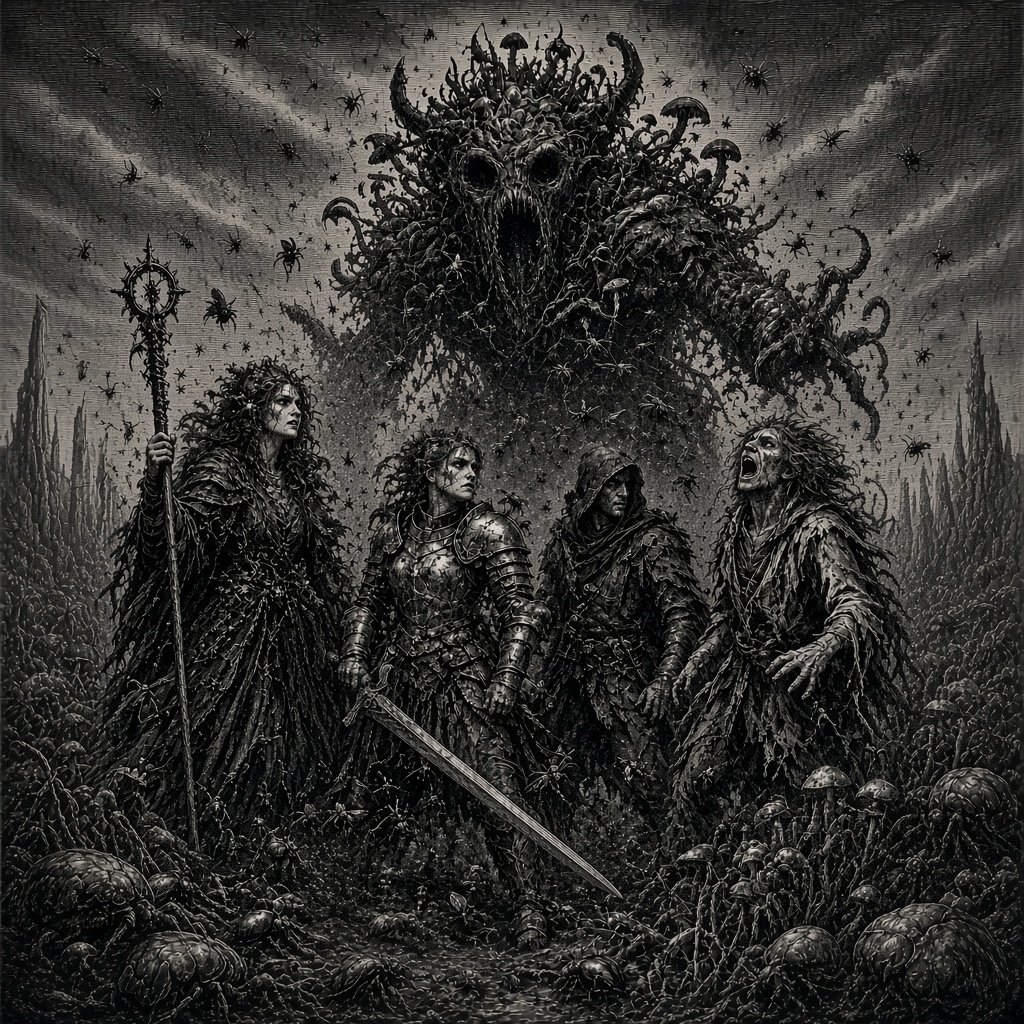
Legion
The captive troll was dragged through the gates of Gravenwaarts, and Magistra Tyrza van Yven had it shut away in the crypts beneath the church, so that it might be learned whether such creatures could be mastered and turned against Sariël. The three were called to stand by, for safety and for whatever incantations might be needed. And only up close, by torchlight, did they see what they had actually caught. For it was not a creature. It was an assembly: frogs and tree stumps, marsh plants and mushrooms, and living animals that had somehow been joined together and moved as though they were one. The stench of rot had soaked through the whole church, and whoever stepped outside drew breath like someone surfacing from deep water.
Tyrza admitted that this went beyond her craft. She had never spoken with angels, nor with devils, and she did not know which consciousness dwelt here, or how many dwelt here. Then the three searched their memories. Hadewych and Jezebel recognised an old theme from the painted hells: fish and frogs, the signs by which painters mark a thing as unclean and evil. But Jezebel went further, for her mind is her weapon as the greatsword is Hadewych's. She remembered the tale of the possessed man who was asked his name, and who answered: my name is Legion, for we are many. And she carried that name to Tyrza, and said: this is one that is many.
Yet who speaks with a multitude? The three thought of Johannes the Fool, who understands strange tongues. He walked free now, for he was no longer counted a danger to the peace, and they found him deep in the catacombs, setting signs on the walls in chalk: letters that were not letters, the same unknown script they had seen upon the Watcher. He was in a trance and did not hear them. They tapped him on the shoulder. He turned his head with a jerk, and his eyes were wild and did not blink, and he looked straight through them as though he caught the voice but not the speaker. Then he put out his hand and touched Jezebel's face, to feel whether she was real. And when he returned, what stood on his face was not the joy of a man waking, but the disappointment of a man falling back into reality. He let himself be led, but warily, looking about him at every step.
In the crypts the beast had sagged. Whatever had once held it together and made it so formidable an enemy seemed spent; the limbs could still be made out, but it was becoming more a pool than a figure, and a snake crawled away out of the branches. There was haste in it now. Yet Johannes could not speak the tongue. He understood it only in his visions, and those came over him in sleep; once he called them up by eating heaven-iron, now they simply fell upon him. Then Tyrza spoke the proposal nobody had wanted to hear: that the three should go down into the same sleep. She would keep watch, hold the circles and the barriers so the creature could not break out, and wake them within the hour. Jezebel agreed first, for a wizard does not walk past such a door. Jakobus had little appetite for it, as a thief seldom has appetite for sleeping among enemies. Hadewych said that she was only a simple soldier, but that an order remained an order, and she chose the corner by the exit, the most dangerous one, so that nothing would pass her. So they divided themselves with Johannes across the four corners of the room. Jezebel spoke a sleep spell, and the spell refused her; it slipped from her hands that day and did not come back. So they slept the way people sleep, tired from trolls and from running.
And the sleep that took them was unclean. Something crawled over their skin, like insects, and like a sickness spreading slowly beneath the flesh. They stood on a plain that teemed, and the air was thick with flies and mosquitoes, and at first none of them could see the others. Jezebel called their names through the droning, and so they found one another, and saw with horror how many of those creatures ran over each other's bodies. Hadewych kept her sword ready and did not yet strike. Johannes appeared as well, and said that he had never been in this place before. Then he brought forth sounds that were not words, and the swarming gathered. It formed a silhouette, and in that silhouette appeared two hollows where eyes belong and an opening that might be a mouth. And it spoke back. They recognised not one word and understood perfectly all the same what it said: go away, and leave me in peace.
But they did not go away. They said that the army of Sariël was coming to lay waste their cities, that it was too great for them alone, and that they needed help. Then it asked what would be better if they won. For where there is war, there are dead; and where there are dead, there is rot; and the rot is its house. After that it named its price. Six corpses a day, every day, from whichever side, man or animal, and never fewer; and the fighting was not to end. If the number was not met, it would feed on them instead. There was no bargaining. They had no mandate to seal such a thing, and Hadewych said aloud what all three were thinking: if we break the pact we are lost, and if we refuse it we are lost as well. So they agreed, and Johannes with them, knowing there was no way out any more. And at that word the swarm poured up their legs, higher and higher, as far as their faces; they struck at it and there were too many, and the creatures crawled into their mouths and down their throats. Jezebel got out one last thing: we were to feed you, not you us. Then they woke screaming on the stones of the crypt.
Tyrza did not want to know the terms. It had worked, she said, and that was what counted. And indeed the marsh creature stood still; it threatened no longer, it had become serviceable. Yet the price had to be counted out, every day anew. They spoke of how such work does not belong to three warriors but to an office, a duty that goes on after they fall; and Tyrza wanted one day fulfilled before she would draw others into it. Then Jakobus went hunting, and there his craft showed itself, for he reads ground the way another reads a page. The phase-spiders he left alone: whoever feeds a devourer of reality to a demon does not know what he is raising. In the pools of the marsh he found other life, eel-like fish, many times larger than in the world they came from, with heads without eyes and teeth like knives. They were hard to take hold of, and only with the help of others from Gravenwaarts, who had tried the same before, did one come up out of the water. One of the six. The creature seized the carcass with a claw that resembled the root of a pollard willow, and slurped it in. So it repeated, hour upon hour, slower and heavier than they had hoped. And when evening fell the plan stood: the next time they would ride out against the men of Sariël. For war brings forth what the pact demands.
The chronicles of Tartarus are not yet complete.
The Watchers still call. The mill turns slower,
its shadow points toward the abyss.
Sariël's armies gather. The sky grows thinner.
To be continued …